Sep 19, 2025
Ideal Ingredients for a Heat-Protecting Formulation
Hair needs protection against excessive heat exposure. Heat energy from thermal styling equipment is high enough to denature the keratin of hair fibre and cause damage to its cosmetic features. Hair loses its protein content, becomes dry and fragile, and increases the friction on the cuticle surface. Heat also causes colour fading and loss of hair’s natural shine.1-4 Thermal-protecting formulations are designed to address the adverse impact of heat. Their main objective is to control heat penetration, preserve the keratin structure, and enhance the shine of the cuticle layer. Besides this, the thermal protecting lotion also facilitates combing on wet & dry hair, removing tangles and making hair feel soft.
So, what ingredients make a heat-protecting lotion?
This blog describes choosing the right and ideal ingredients to formulate a heat-protecting lotion. Let’s go through it.
What makes an ingredient offer heat-protecting benefits?
An ideal heat-protecting ingredient is a substance that can withstand excessive & repeated heat exposure. Moreover, it needs to be scalp and hair-friendly and should positively affect the overall health and well-being of hair. As blow drying and flat ironing may generate smoke, this could be hazardous for the health of customers and hair stylists working in the salon, the ingredients should have a high smoke point. This means it should not degrade or burn easily and be thermally stable for the heat generated during blow drying & flat ironing.5
The blend of these ingredients should also glossify the fibers, improving their light interaction and offering a pleasant, radiant outlook.
Key factors in choosing the heat-protecting ingredients
Two key factors are considered in choosing an ingredient for heat protection
◉ Stability against heat energy
◉ High Smoke Point
A smoke point is the temperature at which a material degrades and burns, emitting smoke. This demonstrates its chemical degradation, and a high smoke point temperature highlights its thermal stability.
How do they work to protect Hair?
The cuticle is the first site of interaction and heat energy from thermal equipment is transferred through this cuticle layer reaching deep inside the cortex center. Hair needs some insulating material on the cuticle layer that can minimize the rate of heat transfer. This coating is very fine, delicate yet uniform on the cuticle layer ensuring that the whole strand is covered from the roots to the tips.
On exposure to heat, this coating serves its objectives and slows down the energy transfer, preserving the underlying keratin fiber.
Top Choice Ingredients for Heat Protection & Their Smoke Points
Keeping insight into the above criteria, our top choice ingredients are listed below along with smoke points.
◉ Dimethicone (326 oC)
◉ Refined Avocado Oil (271 oC)
◉ Refined Safflower Oil (266 oC)
◉ Sunflower Oil (252 oC)
◉ Mustard Oil (250 oC)
◉ Butyrospermum Parkii (Shea) Butter (233 oC)
◉ Almond Oil (221 oC)
◉ Argan Oil (220 oC)
So, where do we find these ingredients? Blending them in a product and extracting maximum benefits.
The answer is
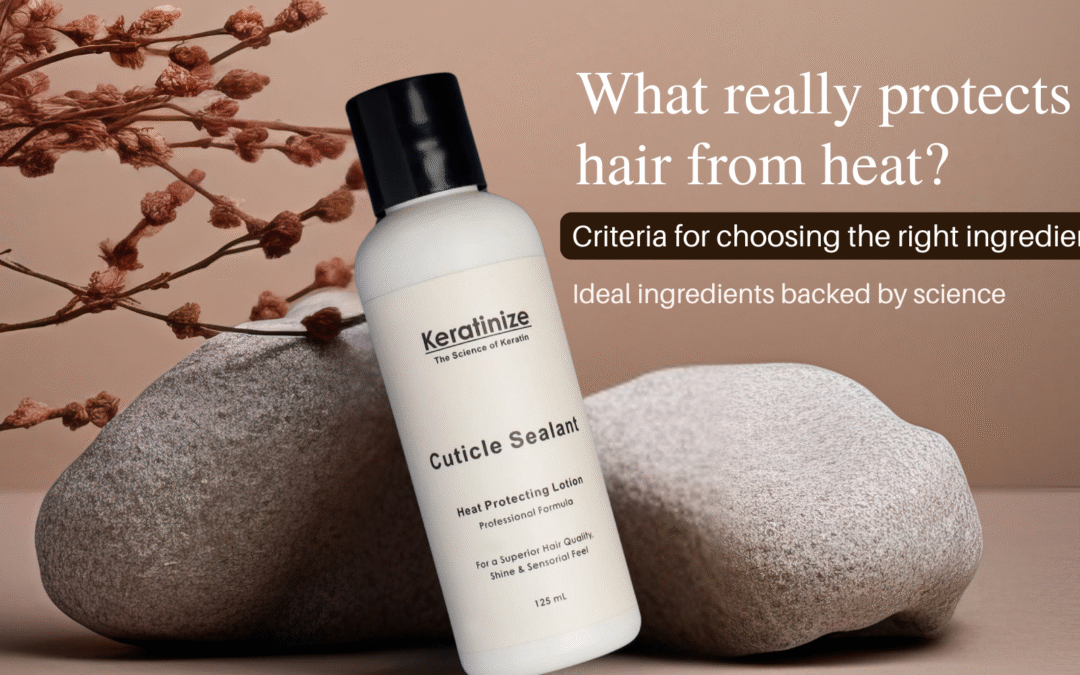
The Keratinize Cuticle Sealant
A product composed of sunflower oil and multi-functional high-tech modified silicones that are carefully selected to protect hair against heat exposure. The formulation also contains cetrimonium chloride, which is a light-textured and moderate molecular water hair-softening agent that also combats static charge density on medium to high porosity hairs.
Cuticle sealant also contains hydrolysed keratin, a potent cuticle smoothening and cortex-strengthening agent. During heat exposure, this naturally derived material plasticises with the keratin of hair fibre and enhances its mechanical strength. Shea Butter provides a special sensorial feel to dry hair, whereas, Zinc PCA ensures water-balance on thermally styled hair.
Unique Features of Keratinize Cuticle Sealant
◉ Light – Texture Creamy Lotion
◉ Non-greasy and no oil residues leftover
◉ Sunflower Oil, a key heat-protecting ingredient
◉ Multi-functional silicones to offer heat protection, shine, and cuticle smoothness
◉ Never let your hair dry out. Re-balance the hair’s moisture content after heat exposure.
What do you get in the end?
◉ Beautiful, Vibrant, Shiny Hair with a natural body & texture
References & Further Reading
1. Vagkidis, N.; Li, L.; Marsh, J. M.; Chechik, V., Synergy of UV light and heat in peptide degradation. Journal of Photochemistry and Photobiology A: Chemistry 2023, 439, 114627.
2. Lima, C. R. R. d. C.; Couto, R. A. A. d.; Freire, T. B.; Goshiyama, A. M.; Baby, A. R.; Velasco, M. V. R.; Constantino, V. R. L.; Matos, J. d. R., Heat‐damaged evaluation of virgin hair. Journal of cosmetic dermatology 2019, 18 (6), 1885-1892.
3. Harper, D.; Qi, J. C.; Kaplan, P., Thermal styling: efficacy, convenience, damage tradeoffs. Journal of cosmetic science 2011, 62 (2), 139-147.
4. Gamez-Garcia, M., The cracking of human hair cuticles by cyclical thermal stresses. Journal of the Society of Cosmetic Chemists 1998, 49 (3), 141-153.
5. CORBETT, J. F., The chemistry of hair‐care products. Journal of the Society of Dyers and Colourists 1976, 92 (8), 285-303.

Sep 19, 2025
How to Treat Heat-Damaged Hair
Thermal Hair Styling is one of the first grooming techniques adapted to style and manage scalp hair fibers.1 Iron rods and curling pads made of metallic plates were first heated in an oven, and then hair fibers were wrapped around them. This ancient technique offered promising results and gained popularity despite exposing hair, scalp, and consumers to hot metallic rods. Over the years, the equipment improved, and more user-friendly techniques were developed, especially addressing safety concerns.
Today, curling rods, flat irons, and blow dryers are used by all types of consumers. Besides the benefits of hair styling, grooming, and facilitating hair manageability, heat processing damages hair fibers. These techniques expose hair fibers to a heat source at high temperatures. The previous blog discussed the detailed mechanism and nature of changes inside the hair structure. This blog discusses how to preserve hair fiber against repeated heat exposure and minimize the adverse impact of heat on hair health.
How can we repair the damaged hair fibers to restore their natural outlook, body, and texture? Let’s find out the answer to this question.
Signs of Heat-induced damage to Hair
Excessively heat-processed hair fibers show visible signs of damage. A few of them are listed here
◉ Dryness
◉ Rough feel
◉ Broken hair strands
◉ Split ends
◉ High hair porosity
◉ No definite curl shape
◉ Color fading
Microscopic analysis reveals that heat damages the surface smoothness and causes rupture of the fiber structure.
A Quick Look at Damage Mechanism: What Happens to Hair on Heating?
Heat exposure to hair fibers during thermal styling degrades hair keratin and induces permanent changes in protein structure. Keratin can not withstand excessive heat and will denature. This alters the nature of protein and changes the physical and chemical properties of hair fiber. Damage to hair protein undermines the mechanical strength of hair fiber, its cosmetic features, and its texture.2-4 Hair also loses its total protein content and becomes porous.
Heat application also removes water from the hair surface. The heat energy evaporates the hair’s moisture content, and water molecules escape from the cuticle surface. Under high energy conditions, steam formation underneath the cuticle layer causes a bump formation on the surface, leading to abrupt rupture and breakage on the hair surface. This endangers the integrity of hair fibers and leads to hair breakage. These bumps or chips have been observed under the microscope for heat-processed hair fibers.5-6
Big Question: How to Repair Heat-Damaged Hair Fibers
Heat-damaged hair fibers require a customized, specifically formulated hair care regimen to restore their natural texture and body. Here are some key aspects of repairing heat-damaged hair fibers.
Hydration for Thermally Processed Hair
Water is the key to hair life. Heat processing diminishes the hair water content and makes hair dry, rough, and brittle. Localized steam formation damages the cuticle layer and alters the surface properties, making it difficult to comb, brush, and style. Hence, it is vital to add and maintain the moisture level of hair fibers. Hair care products containing humectants and hydrating agents are strongly recommended for this job. Also, consumers should avoid using any hair care product that contains drying alcohol (e.g, ethyl alcohol) or other harsh chemicals (SLS, sodium hydroxide, etc.) that can dry the hair fibers. Our recommended humectants and hydrating ingredients are
◉ Vegetal Glycerin
◉ Propanediol
◉ Alpha Hydroxy acids, preferably Lactic acid and Sodium Lactate
◉ Sodium PCA or Zinc PCA
◉ Betaine
◉ Panthenol
◉ Aloe Vera Juice or Gel
◉ Ceramides
◉ Emollients
Emollients are key ingredients that prevent the loss of water molecules from the hair surface. They are generally hydrophobic liquids that form a water-resistant layer on the hair surface and therefore, minimize water escape. Natural emollients are preferred because of their multifunctional benefits, green origin, and sustainable supply chain. Deep Conditioning products, e.g. Rinse-Off Conditioners, Deep Conditioning Masks, and leave-in conditioners, should contain these natural emollients to improve the quality of heat-damaged hair fibers. These natural emollients also enhance the sensorial texture and dry feel following the application. Our selected and preferred natural emollients for heat-damaged hair fibers are
◉ Shea Butter
◉ Cocoa Butter
◉ Mango Seed Oil
◉ Babassu Oil
◉ Coconut Oil
◉ Apricot Kernel Oil
◉ Meadowfoam Seed Oil
◉ Baobab Oil
The best way is to have a blend and combination of two to three different oils or butter in a formulation. For heat protection, the selected natural oil should have a high smoke point to avoid smoke formation during thermal styling.
Keratin
Keratin and related amino acids are excellent active ingredients that target the cuticle surface and inner cortical structures. The application of keratin on heat-processed hair improves the surface smoothness of the cuticle layer, and because of their hydrophilic nature, proteins also enhance fiber moisture levels.
Silicones
Silicones are multifunctional materials with strong surface coating properties and water repellency. They are excellent surface smoothening agents that address cuticular friction and minimize fiber-to-friction friction. These ingredients are highly stable and do not undergo any degradation or molecular breakdown during heat exposure. That’s why they demonstrate excellent heat protection to hair fiber during blow drying and flat ironing. Having a small dosage of silicone oils can preserve hair proteins and minimize the adverse impact of excessive heating. Some key heat-protecting silicones are
◉ Dimethicone
◉ Cyclomethicone
◉ Cyclopentasiloxane
◉ Phenyltrimethicone
◉ Amodimethicone
There is nothing wrong with using silicones as long as they are used in small dosages and low frequency.
How can we repair the damaged hair?
Repairing damaged hair fibers requires a comprehensive strategy to restore their surface quality, shine, sensorial, texture, and hair body. Besides having good quality and customized hair care products, it requires a well-thought-out plan of a day-to-day hair care routine, consistency, continuation, dedication, and commitment. There is no such magic product to fix the problem. One needs to try a set of products and figure out what works for their hair. More importantly, keep it simple and work out the basics. This will ensure a cost-benefit and yet an effective hair care regimen. Some key tips are described below as a basic guideline.
Key Tips to Restore Hair Texture
◉ Prevention is better than cure. Try to cut down on heat processing.
◉ Use normal air-blow drying instead of hot air.
◉ Use a low heat level for flat ironing.
◉ Always apply a Heat-Protecting lotion before blow drying or flat ironing.
◉ After washing, always remove excess water using a towel. Applying heat to wet hair causes more damage to the fiber.
Recommended Product
Keratinize Cuticle Sealant is a specially formulated product to minimize the impact of heat on hair, control water loss, and prevent hair breakage. It is a blend of humectants, natural emollients, and thermally stable yet volatile silicones. This formulation offers fiber detangling, cuticle alignment, and minimal protein loss. It prevents water loss from the fiber and imparts intense shine by improving light interaction with the hair fibers. Strongly recommended for medium to high-porosity hair, especially chemically processed hair fibers with bleach, perms, permanent colors, and straighteners.
Summary
Heat-damaged hair fibers are dry, brittle, and rough. They are difficult to style and manage during everyday grooming. These hair fibers require a comprehensive and customized hair care regimen to restore their natural outlook, shine, texture, and body. Keratinize Cuticle Sealant offers a thermal shield against heat exposure and is strongly recommended for hair care consumers who often employ heat styling.
References
1. Zviak, C., The Science of Hair Care. Taylor & Francis: 2005.
2. Shiel, S., Hair health and management of common hair disorders. Journal of Cosmetic Dermatology 2007, 6, 12-17.
3. Vagkidis, N.; Li, L.; Marsh, J.; Chechik, V., Synergy of UV light and heat in peptide degradation. Journal of Photochemistry and Photobiology A: Chemistry 2023, 114627.
4. Wortmann, F. J.; Wortmann, G.; Marsh, J.; Meinert, K., Thermal denaturation and structural changes of α-helical proteins in keratins. Journal of Structural Biology 2012, 177 (2), 553-560.
5. Crawford, R.; CR, R., A hysteresis in heat dried hair. J. Soc. Cosmet. Chem 1981, 32, 27-36.
6. Tanamachi, H., Temperature as a moisture cue in haptics on hair. Inter. J. of Cosmet. Sci 2011, 33 (1), 25-36.


